Service
Tree Trimming & Pruning in Austin, TX
Healthier structure, safer clearance, better-looking trees.
- Serving Austin since 1975
- Certified arborists on staff
- Fully licensed & insured
- Residential & commercial
Pruning is the single highest-return thing you can do for a mature Central Texas tree. Done correctly, it removes the deadwood and crossing limbs that invite decay, opens the canopy so wind passes through instead of pushing against it, and lifts branches off your roof, driveway, and power drop.
Done incorrectly — topping, lion-tailing, flush cuts, or pruning oaks during high-risk months — it shortens the life of a tree that took forty years to grow. Austin Tree Specialists has pruned Austin's canopy since 1975, and every cut we make is a decision, not a habit.
When a tree needs pruning
Trees in Austin yards rarely fail all at once. They accumulate small structural problems — a codominant stem with included bark, a heavy lateral extending over the roofline, a cluster of deadwood in the interior — and then a 60 mph gust in a May thunderstorm finds the weak point.
Pruning is preventive. It is far cheaper to shorten and lighten an overextended limb today than to remove a split trunk, patch a roof, and replace a fence after the fact.
- •Branches touching or rubbing the roof, siding, or service drop
- •Deadwood hanging in the canopy after a drought summer
- •Codominant trunks with a tight V-shaped union and included bark
- •Long, bare limbs with foliage only at the tips (lion-tailed growth)
- •Low limbs blocking driveways, sidewalks, or line of sight at the curb
- •Canopy so dense that turf and beds beneath it have thinned out
Our process
- 1
On-site assessment
A certified arborist walks the property, identifies species, checks for decay, cavities, and previous poor cuts, and defines an objective for each tree — clearance, structure, deadwood, or reduction.
- 2
Written scope and price
You get a plain-English scope: which trees, what type of cuts, how much clearance, and a fixed price. No surprise add-ons after the crew arrives.
- 3
Safe access and setup
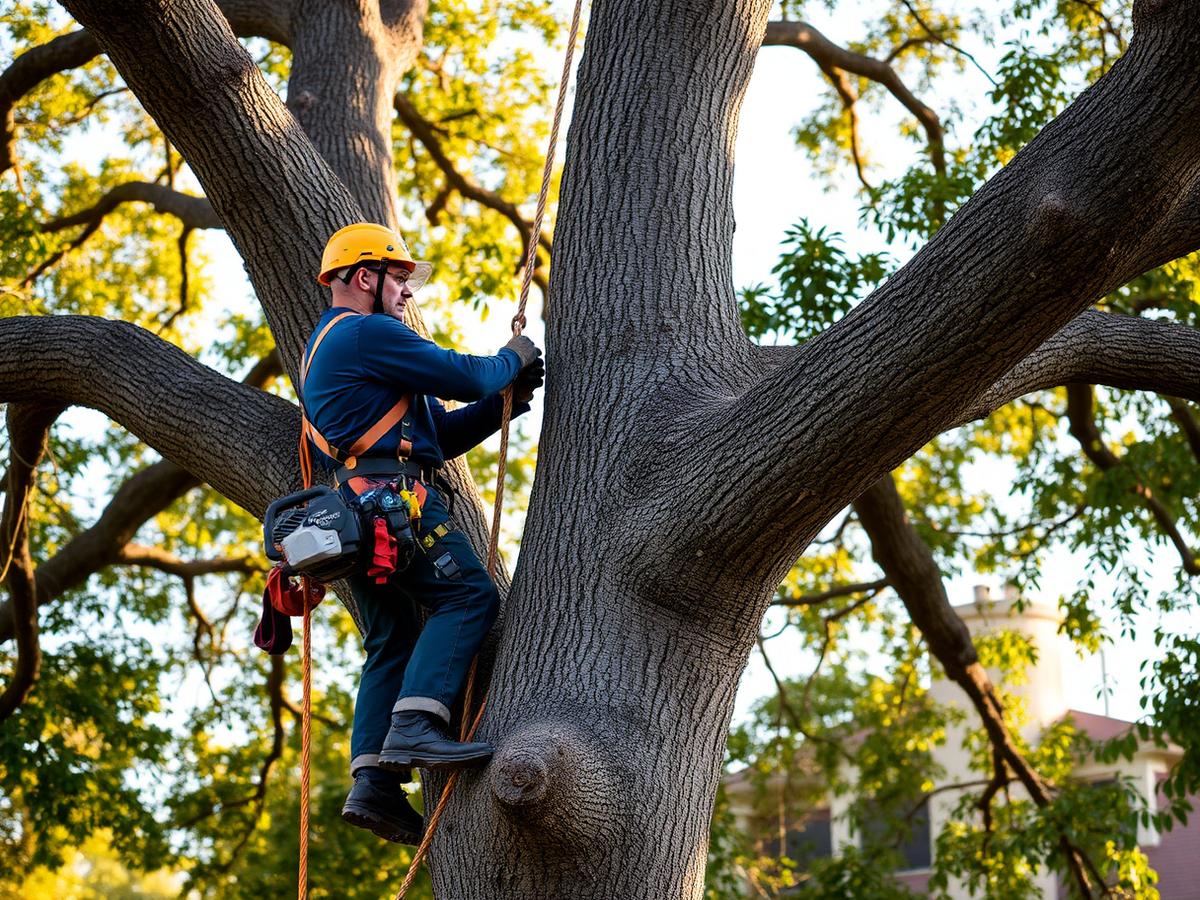
We tarp beds, protect irrigation heads, and rig from the tree rather than driving equipment across your lawn wherever access allows.
- 4
Precision cuts
Reduction cuts to a lateral, proper collar cuts, no topping, no climbing spikes on trees that will remain. Oaks are sealed immediately when pruning is unavoidable during risk season.
- 5
Cleanup and walkthrough
Debris chipped and hauled, surfaces blown clean, and a walkthrough so you see exactly what was done and what to watch next season.
Why Austin homeowners choose us
- ✓50+ years pruning the same species, soils, and storm patterns across the Austin metro
- ✓Certified arborists direct every job — not a salesperson with a chainsaw crew
- ✓Strict oak wilt protocol: timing, sanitized tools, and immediate wound sealing
- ✓Fully insured with general liability and workers' compensation, certificates on request
- ✓Honest recommendations — we routinely tell homeowners a tree needs less work than they expected
Local expertise
Austin's signature live oaks respond well to light, frequent maintenance and badly to heavy removals of interior foliage. We thin selectively and preserve interior growth so limbs stay tapered and strong.
Cedar elms hold dense, twiggy growth that traps wind. Careful interior thinning reduces sail effect without stripping the tree.
Ashe juniper (cedar) on hill country lots is usually pruned for clearance, fuel reduction near structures, and view corridors rather than shaping.
Post oaks are extremely sensitive to root disturbance and over-pruning; on those we take the most conservative approach on the property.
What affects the price
| Tree size and species | A 20-foot crepe myrtle and a 70-foot heritage live oak are different jobs entirely. |
|---|---|
| Objective | Deadwood-only cleanup costs less than full structural pruning with clearance from a two-story roof. |
| Access | Backyard trees behind a narrow gate require rope-and-rig work and more labor hours than curbside trees. |
| Targets below | Pools, roofs, glass, and power lines require slower, piece-by-piece lowering. |
| Debris volume | Haul-off is priced into the job; on-site chip drops can reduce cost. |
| Season | Oak work scheduled inside safe windows may shift timing but protects long-term tree value. |
Most residential pruning jobs in Austin run $400–$1,800 per visit, with large heritage oaks and multi-tree properties higher.
Recent work
Frequently asked questions
Most mature shade trees benefit from pruning every 3–5 years. Young trees benefit from light structural pruning every 2–3 years, which is the cheapest insurance you will ever buy for a tree.
Avoid pruning oaks from February through June, the peak oak wilt transmission window in Central Texas. Mid-July through January is safest. Any oak wound made at any time of year should be sealed immediately.
No. Topping removes the tree's food factory and forces weakly attached regrowth. When a tree is too large for its space we use crown reduction to appropriate lateral branches, or discuss removal and replanting.
Sometimes. Weight reduction on the leaning side can lower risk, but a lean caused by root plate failure is a structural issue. An arborist inspection determines whether pruning, cabling, or removal is appropriate.
Yes. Every job includes chipping, hauling, and blowing down hard surfaces. If you want chips left for mulch, tell us and we will drop them where you want them.
Get a free estimate from a certified arborist
Straight answers, fixed pricing, and crews that clean up like they were never there.
Since 1975Fully insuredCertified arborists